Can You Use a Calculator on the ASVAB? The Current Rule and How to Do the Math Without One
Last updated: November 26, 2026
No. You cannot use a calculator on any version of the ASVAB: the computer test, the paper test or the at-home PiCAT (officialasvab.com). You get scratch paper and a pencil, and every math question is written to be solved by hand.
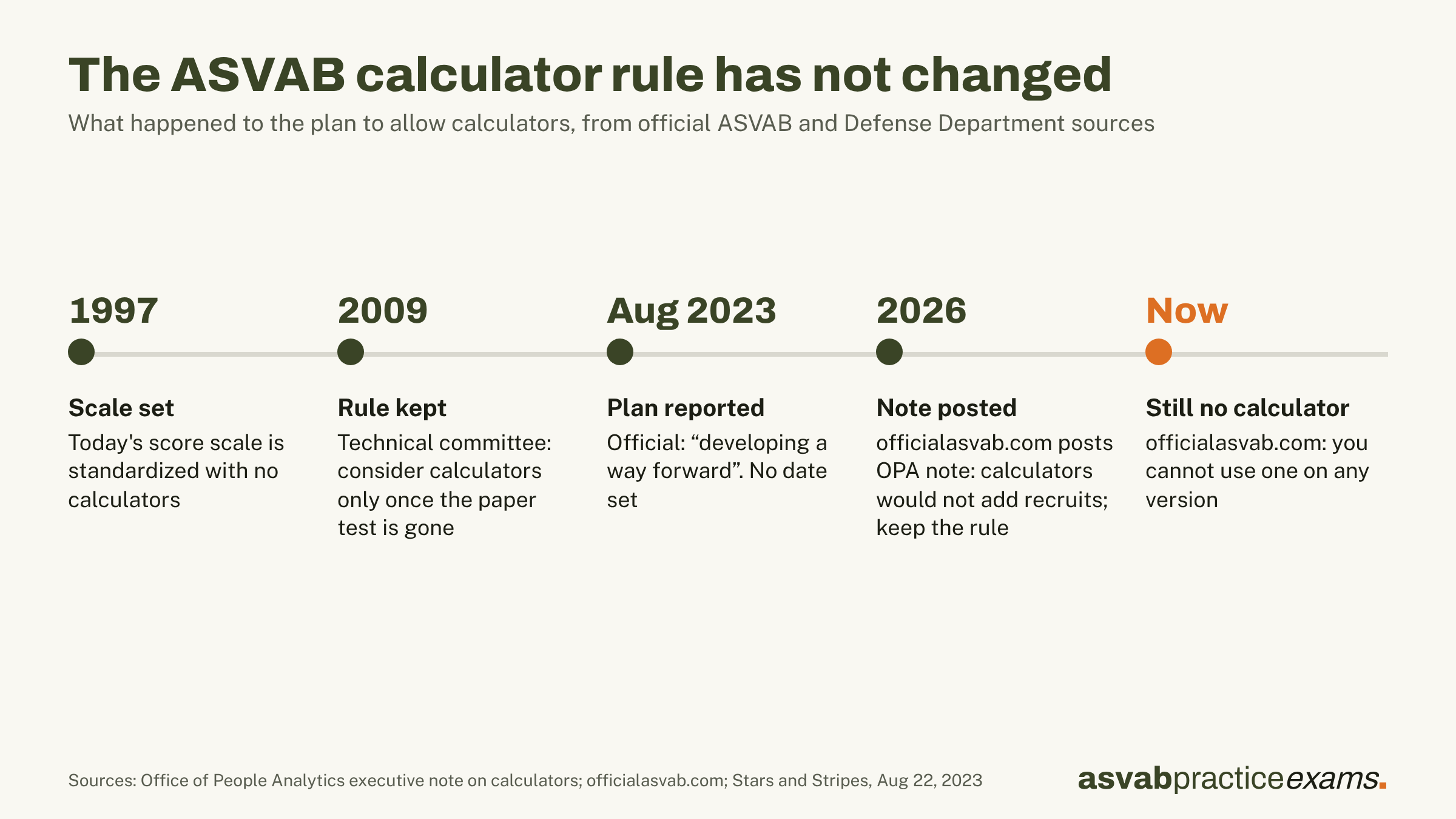
You may have seen 2023 headlines saying the Pentagon would allow calculators. That change never took effect. The official FAQ, updated in October 2026, still explains why calculators are not allowed (officialasvab.com FAQ). This guide shows what happened to that plan, then how to do ASVAB math fast without a calculator, using questions from our free practice exams.
Why the ASVAB bans calculators
The official reason is that the ASVAB is an employment test, not a school test. A school test checks what you learned. The ASVAB checks what you can do on the job, and “the ability to do hand calculations (without a calculator) may be required on the job,” per the officialasvab.com FAQ.
There is also a technical reason. The current ASVAB score scale was set in 1997, and one condition of that standardization was that no one used a calculator (Office of People Analytics executive note). Your score is compared with people who tested that way. Hand them a calculator now and the comparison breaks.
The same note says the questions themselves were written to a specification that examinees do not need calculators to solve them. That is good news for you: the numbers are chosen to work out by hand.
What happened to the plan to allow calculators?
In August 2023, a defense official told Military.com, “We are developing a way forward for calculator inclusion.” No date was set for any change (Stars and Stripes, August 22, 2023).
That plan never became policy. The official reasoning for the rule is set out in an executive note from the Defense Department’s Office of People Analytics (OPA), which does the research behind the ASVAB. The note is dated February 2018, and officialasvab.com posted it in 2026. It recommends that Defense Department accession policy not change the current rule. Its three conclusions:
- It would not add recruits. Scores have to stay comparable with past scores, so the scale would be adjusted to cancel out any calculator boost.
- It would put the test at risk. OPA found the change lacks the technical merit needed and would put the reliability and validity of ASVAB scores at risk.
- It would cost more than it gains. The whole test would have to be standardized again.
A calculator would not lower the bar. OPA writes that after re-standardization, any gain from a calculator "would be statistically eliminated," so "if an applicant does not qualify by taking the ASVAB without a calculator, he or she may still not qualify when taking the ASVAB with a calculator."
What would have to happen first
The note lists the steps before calculators could ever be allowed (OPA executive note):
- End the paper test, or ship identical calculators everywhere. In 2009 a technical committee agreed to keep the rule and consider calculators only after the paper-and-pencil ASVAB is gone, so that everyone could get the same on-screen calculator. The note says enlistment testing is nearly all on computer, but many students in the school testing program still take the paper version.
- Write and field test new questions under rules that assume a calculator, and review every existing question.
- Re-norm the test with a new representative sample and re-link the scale to past scores.
- Set new time limits, because calculator use tends to make people slower.
- Build an on-screen calculator and a practice test for it, and have the technical representatives of the Manpower Accession Policy Working Group review the result before any recommendation to change the policy.
None of that has been announced as done. If you read that the computer ASVAB has a built-in calculator, it is wrong: the official note describes an on-screen calculator only as something that would have to be built and tested first.
The ASVAB math is built to be done by hand
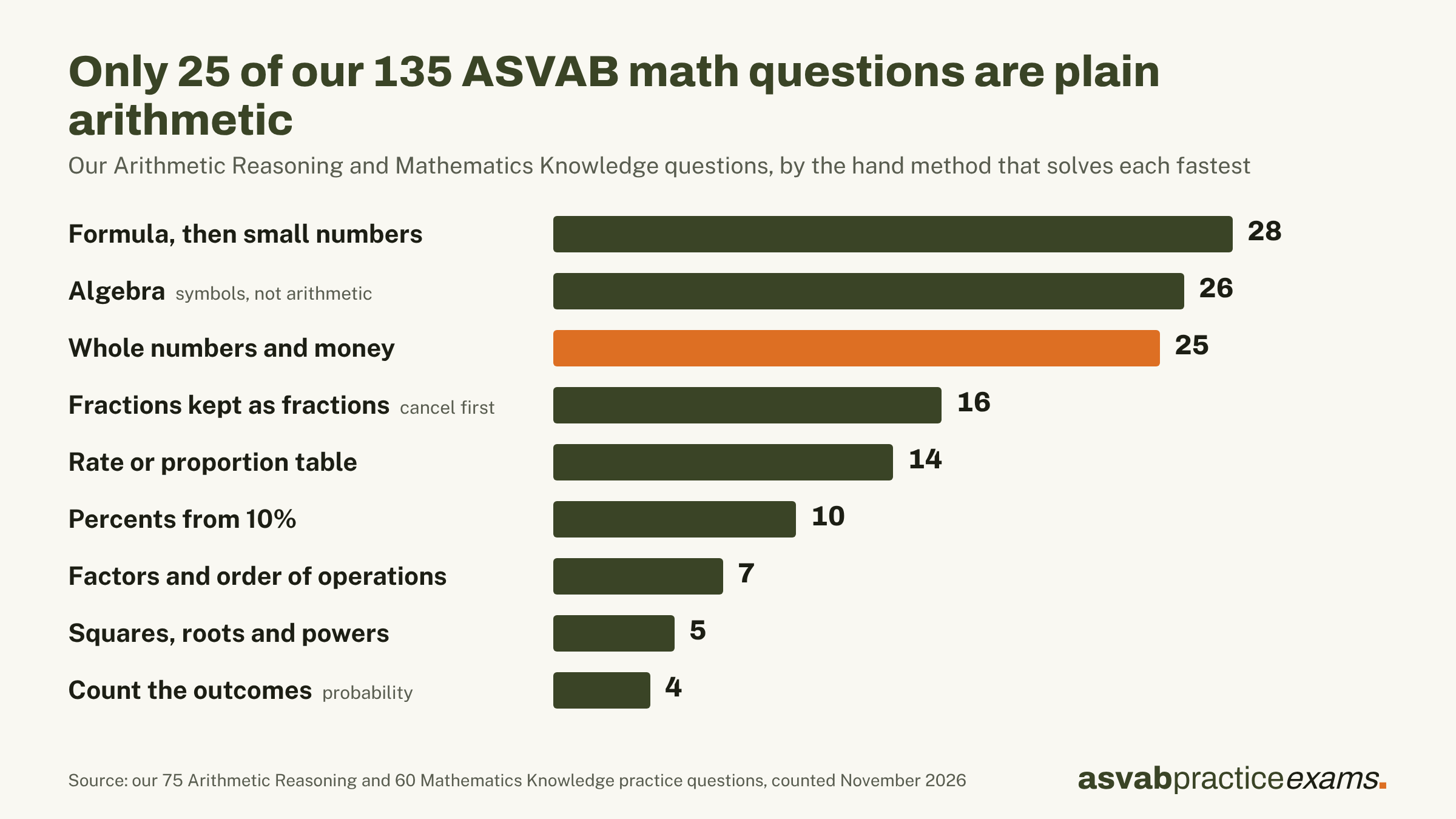
We sorted all 135 math questions on our site (75 Arithmetic Reasoning, 60 Mathematics Knowledge) by the hand method that solves each one fastest. The chart at the top of this page shows the result. Only 25 of them are plain arithmetic with whole numbers and money. The rest reward knowing a method more than computing fast.
The answer keys tell the same story:
| What the correct answer looks like | Arithmetic Reasoning (75) | Mathematics Knowledge (60) |
|---|---|---|
| A whole number | 61 | 32 |
| Dollars and cents | 9 | 0 |
| A fraction or mixed number | 3 | 9 |
| An expression or equation | 0 | 11 |
| An answer with π or a square root | 0 | 4 |
| An inequality | 0 | 3 |
| Other (feet and inches, a clock time, scientific notation) | 2 | 1 |
Counted from our own practice questions. Whole numbers include answers in degrees or with units, and one coordinate point.
Two things stand out. In Arithmetic Reasoning, 61 of 75 answers are whole numbers, so if your working gives you 47.38, check it. In Mathematics Knowledge, 28 of 60 answers are not a plain number at all: an expression like x² + x − 12, a fraction like 17/12, or 45π. A calculator would not have printed any of them.
Five methods that replace a calculator
Each method below comes with a question from our practice exams, solved the way you should solve it on test day.
1. Estimate first, then eliminate
Before you compute, round the numbers and get a rough answer. In our questions the wrong choices are built from a skipped step, so they usually sit far from the right one.
A delivery van gets 18 miles per gallon, and fuel costs $3.80 per gallon. The van makes a 234-mile round trip each day, 5 days a week. What is the weekly fuel cost?
A. $24.70 · B. $49.40 · C. $123.50 · D. $247.00
Answer: D. Estimate: 234 × 5 is about 1,200 miles. 1,200 ÷ 18 is a bit under 70 gallons, and gas is close to $4, so the week costs about $260 to $280. Only D is close. Exact, if you have time: 1,170 ÷ 18 = 65 gallons, and 65 × $3.80 = $247.00. B is one day’s cost. C uses half the round trip.
This question is in Practice Exam 1, Arithmetic Reasoning.
2. Percents from 10%
Find 10% by moving the decimal point one place left. Build everything else from it: 5% is half of that, 20% is double, 15% is 10% plus 5%.
A store raises the $50 price of a lamp by 20%. Later it puts the lamp on sale at 20% off the new price. What is the sale price?
A. $40 · B. $48 · C. $50 · D. $60
Answer: B. 10% of $50 is $5, so 20% is $10 and the new price is $60. 10% of $60 is $6, so 20% off is $12, and $60 − $12 = $48. The trap is C: a 20% rise and a 20% cut do not cancel, because the cut comes off a bigger number.
This question is in Practice Exam 3, Arithmetic Reasoning. Our 75 Arithmetic Reasoning questions include 10 percent problems; all of them are on the Arithmetic Reasoning practice test.
3. Keep fractions as fractions, and cancel first
Do not turn fractions into decimals. Change mixed numbers to improper fractions, then cancel before you multiply so the numbers stay small.
2 1/2 × 1 3/5 =
A. 1 9/16 · B. 2 3/10 · C. 3 7/10 · D. 4
Answer: D. 2 1/2 = 5/2 and 1 3/5 = 8/5. The 5s cancel, leaving 8/2 = 4. B is the trap: it multiplies the whole numbers and the fractions separately (2 × 1 and 1/2 × 3/5), which does not work with mixed numbers.
This question is in Practice Exam 4, Mathematics Knowledge.
4. A rate table for rates and proportions
For “at that rate” questions, write two columns with units at the top and fill in what you know. If 45 copies take 3 minutes, then 15 copies take 1 minute and 150 copies take 10 minutes. You scale by easy steps instead of dividing long decimals. 14 of our Arithmetic Reasoning questions are fastest with a rate table.
5. Know squares and roots by heart
Learn the squares from 1² to 15². Then √144 − √25 is 12 − 5 = 7 in your head, and you can spot that √50 = √(25 × 2) = 5√2. The official note’s own sample item works the same way: 27 ÷ 3 = 9, and √9 = 3.
Write the units on your scratch paper. The wrong answers in the three questions above are not arithmetic slips. They are skipped steps: one day instead of five, a discount taken from the wrong price, fractions multiplied in pieces. Writing each step down is what catches them.
How to practice for a test with no calculator
- Put the calculator away now. Every practice question you solve with one trains a habit you cannot use on test day.
- Know your clock. On the computer test, Arithmetic Reasoning gives you 15 questions in 55 minutes and Mathematics Knowledge 15 in 31 minutes. Full counts for every subtest and both versions are in how many questions are on the ASVAB.
- Drill one method at a time. The Arithmetic Reasoning practice test sorts every word problem in our bank by type, with a stopwatch to hold real-test pace.
- Then take a full exam. Practice Exam 2 and the other three each include both math subtests in the real order and time limit.
- Know why it matters. Arithmetic Reasoning and Mathematics Knowledge are half of the four subtests in your AFQT score, the number that decides whether you can enlist. What counts as a good ASVAB score depends on your branch and your diploma.
More guides on scores and subtests are on the study guide page.
Frequently asked questions
Can you use a calculator on the ASVAB?
No. The official ASVAB site says you cannot use a calculator when taking the ASVAB, on the computer test or the paper test. You get scratch paper and a pencil instead, and every math question is written so it can be solved by hand.
Is there an on-screen calculator on the computer ASVAB?
No. The Defense Department's Office of People Analytics, in its note on calculators, describes a standardized on-screen calculator only as something that would have to be designed and tested, with the whole test re-normed, before calculators could ever be allowed. It recommended against changing the no-calculator policy.
Can you use a calculator on the PiCAT?
No. The official PiCAT instructions say to have scratch paper and a pencil or pen ready and to take the test without any assistance, naming a calculator as one kind of assistance. Your PiCAT scores also have to be confirmed by a short proctored verification test.
Will calculators be allowed on the ASVAB in the future?
Not on the current test. In 2023 a defense official told Military.com a plan was being developed, with no date set, and no change has taken effect. An Office of People Analytics executive note, dated February 2018 and posted on officialasvab.com in 2026, recommends keeping the policy and says any change would first need new questions, field testing and new score norms.
Do you get scratch paper on the ASVAB?
Yes. On the computer test you can press the help key to ask for more scratch paper or another pencil. For the at-home PiCAT you are told to have scratch paper and a pencil or pen ready before you start.
Built and maintained by the ASVAB Practice Exams team. Every question is original, written to a subtest blueprint drawn from the official samples and DoD technical reports, and checked by a second reviewer who answers it without the key. About this site →